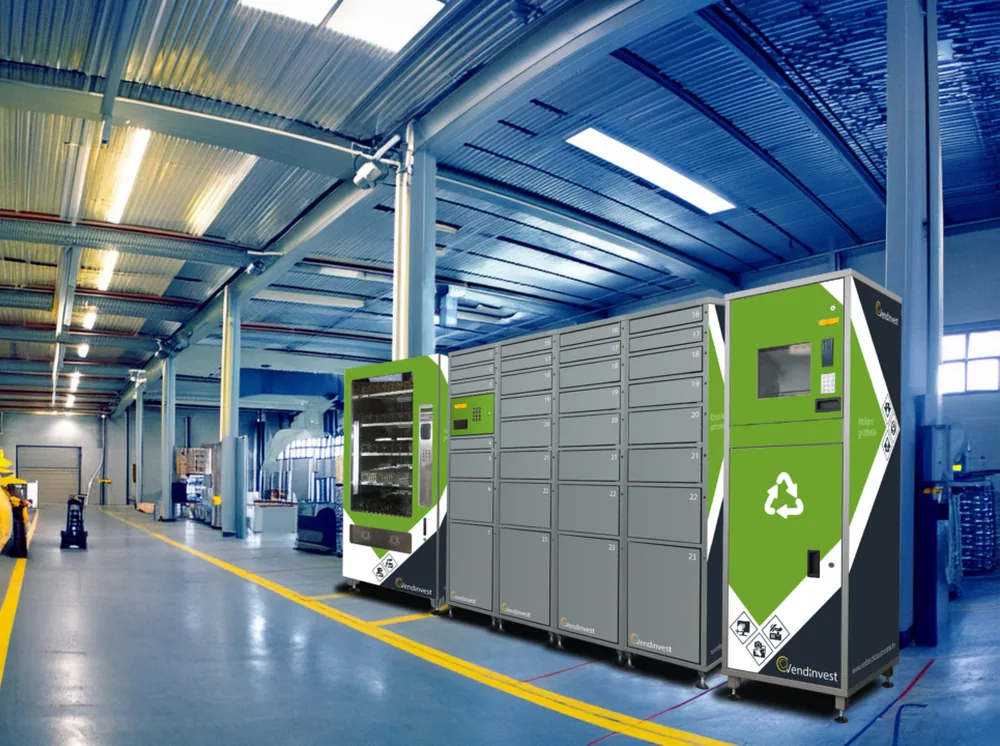
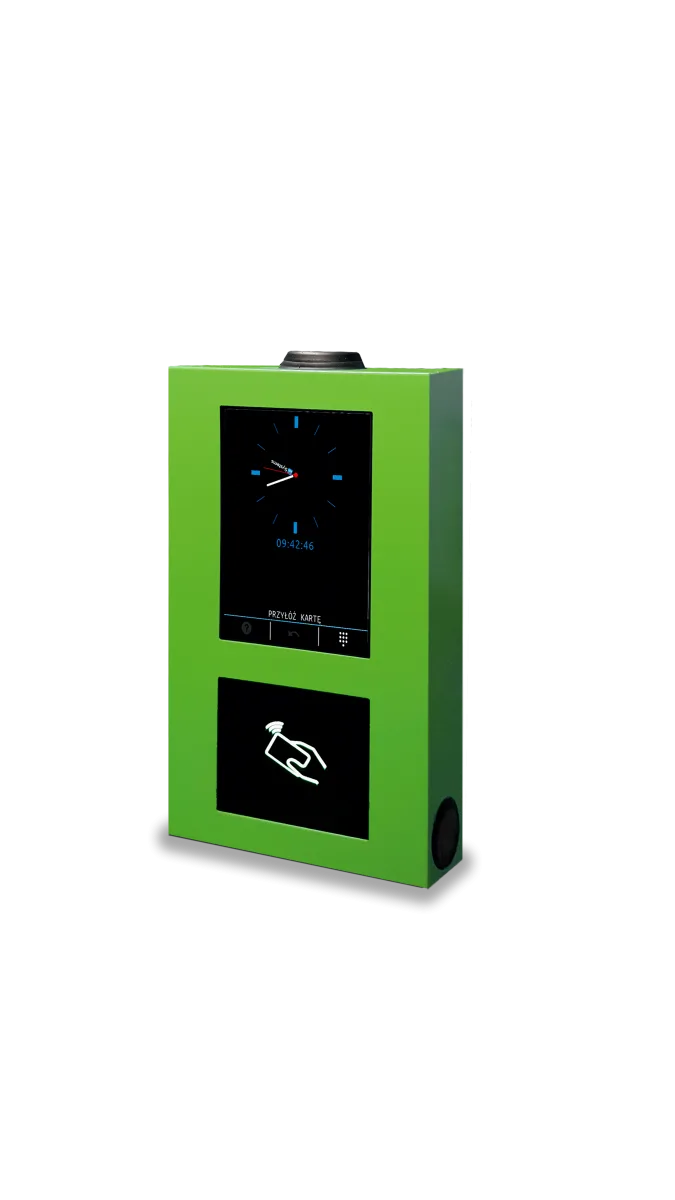

Services and support
From designing the solution through installation to ongoing service and software updates.
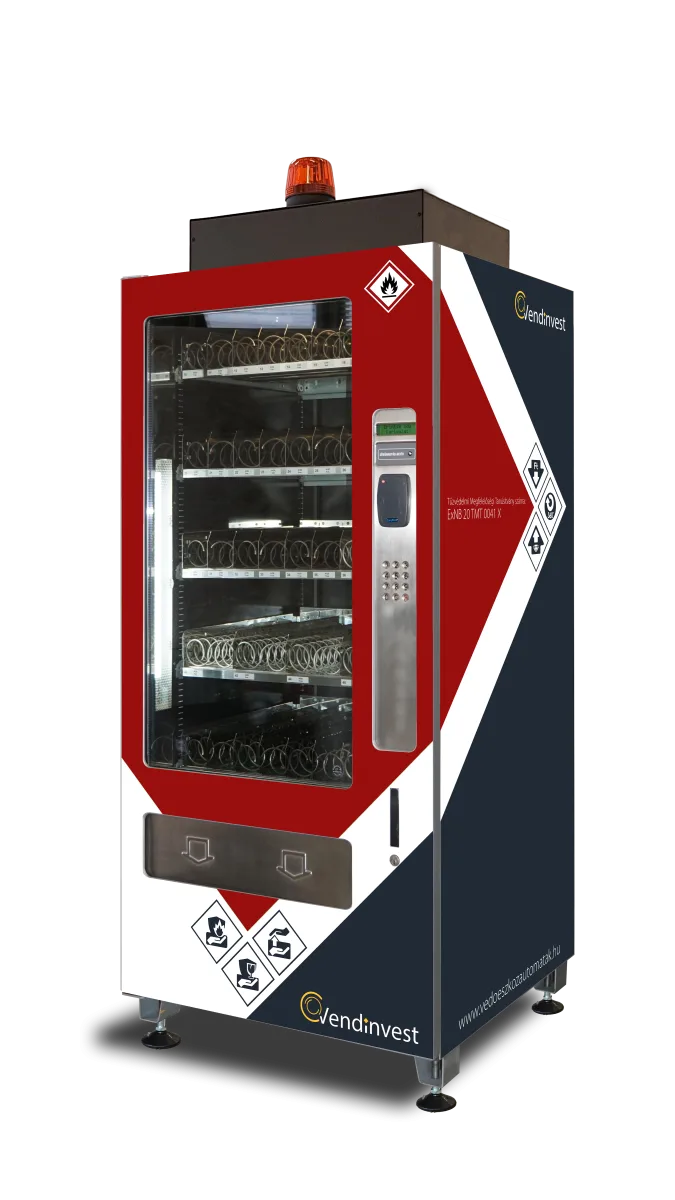
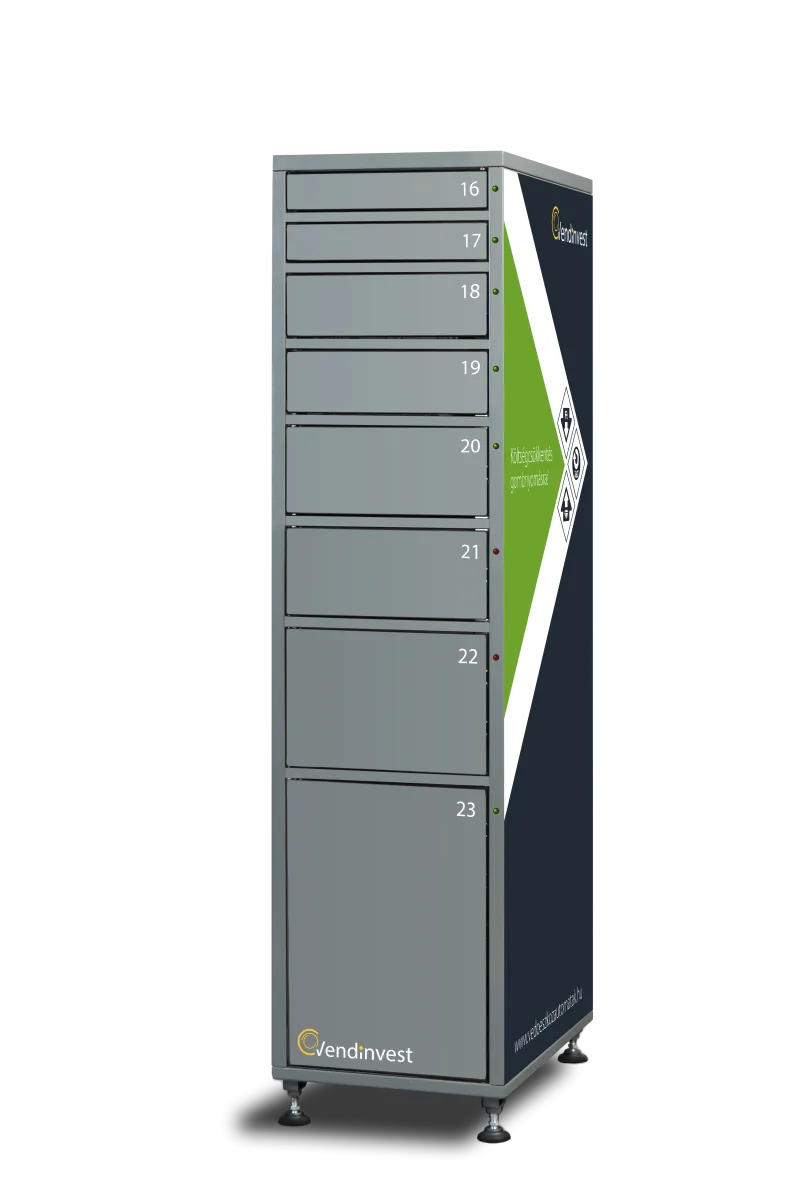
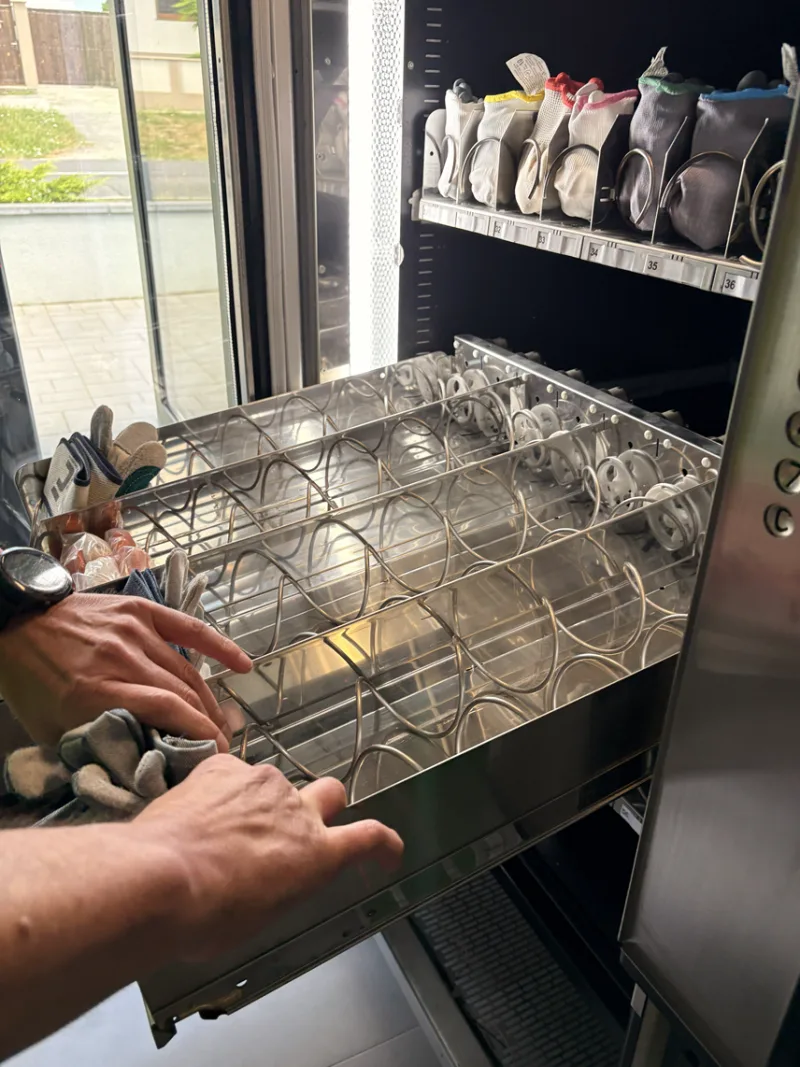
Spiral and lift vending machines
Precise handling of small, valuable, fragile or flammable items.
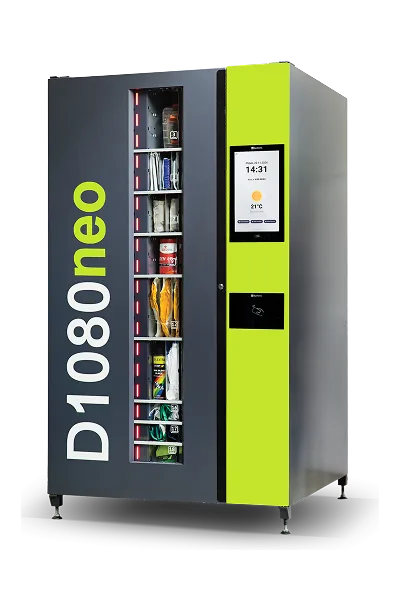
View categoryCarousel storage machines
Record storage capacity in a compact footprint, thanks to a rotating drum.
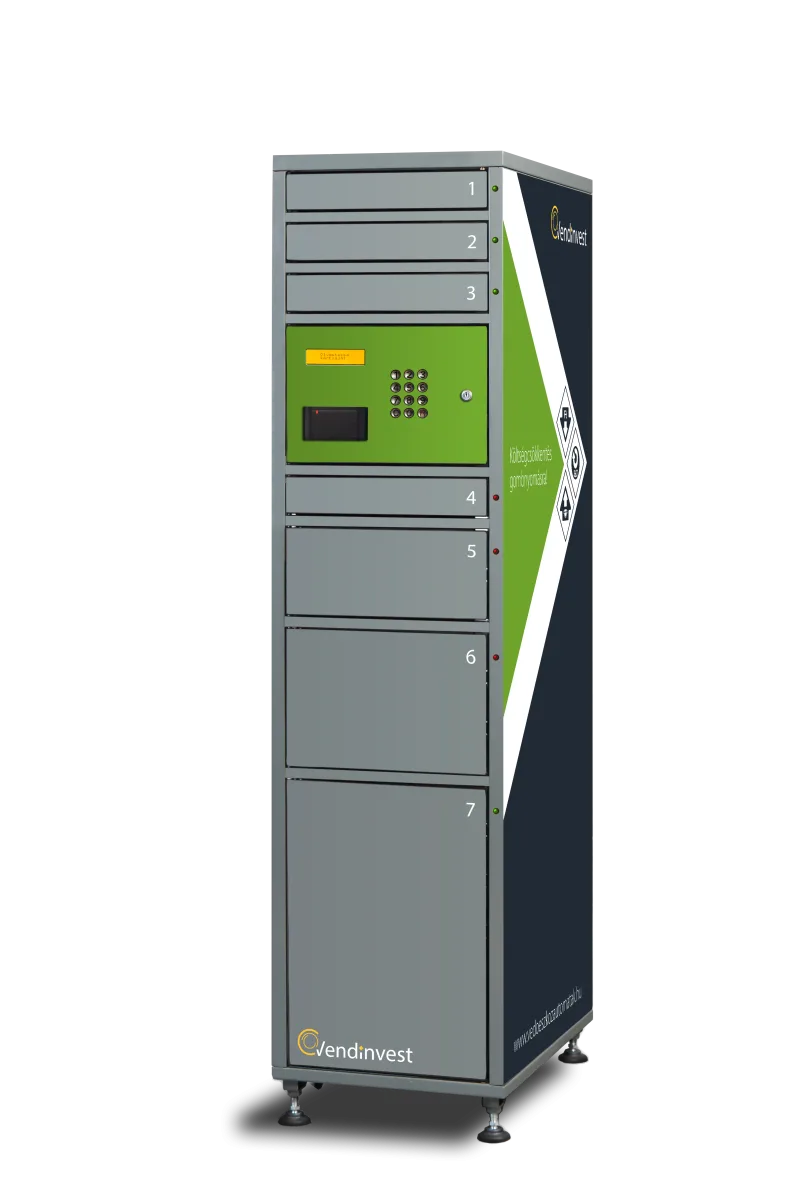
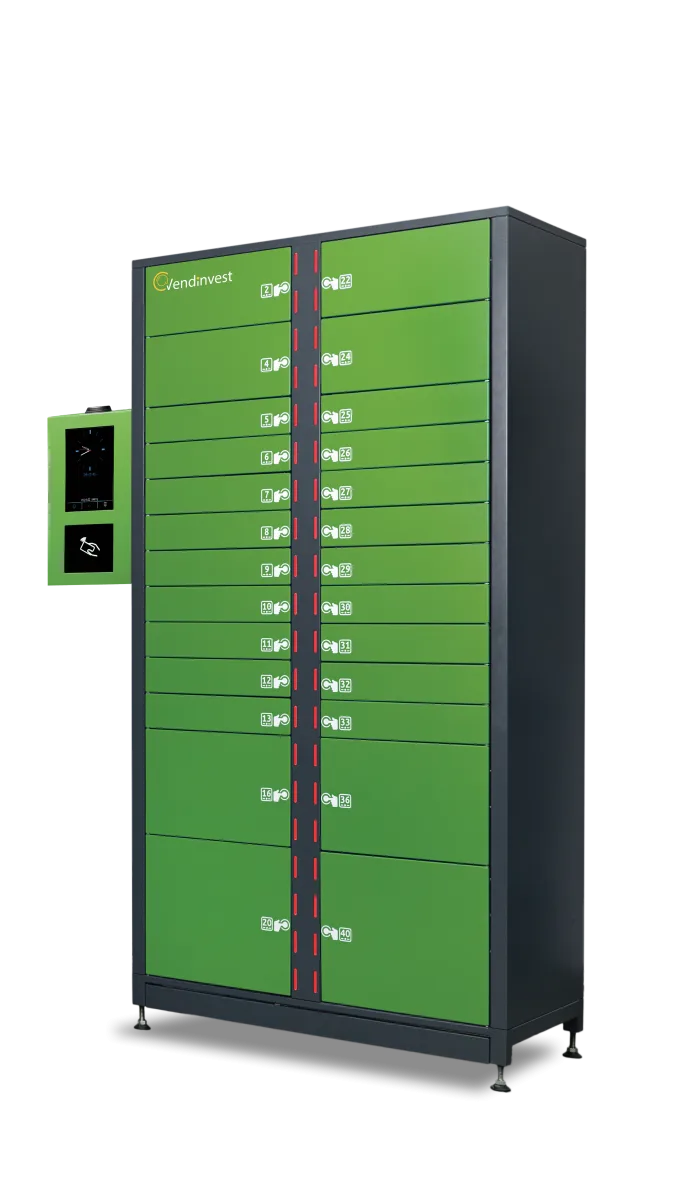
View categoryCabinet dispensing and storage machines
Safe handling of bulky equipment and power tools.
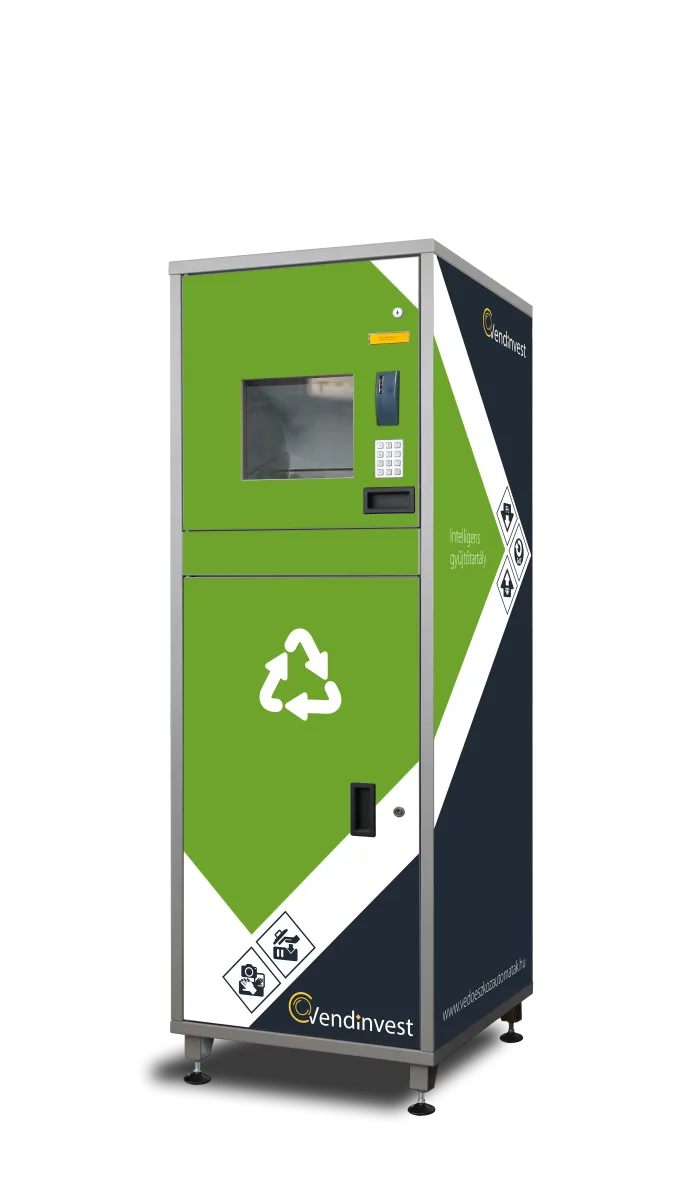
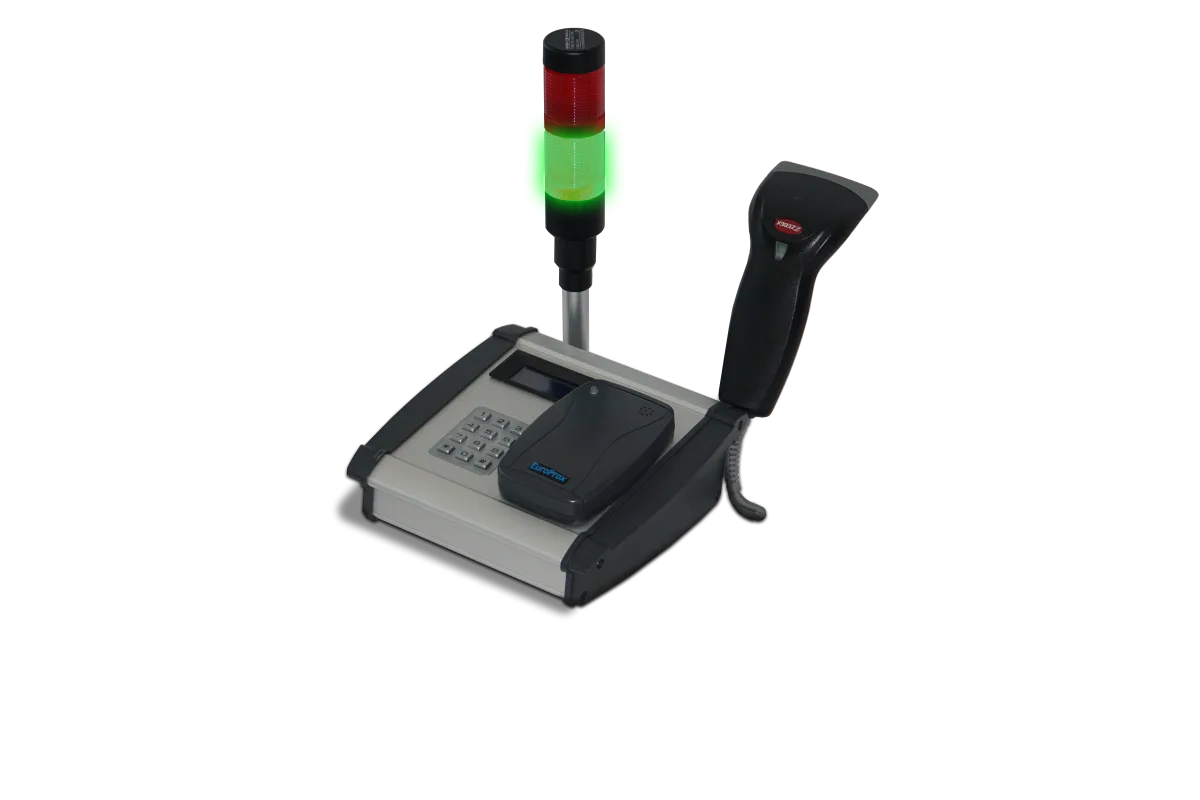
View categoryDecentralised storage and terminals
Dispensing and record keeping wherever the work happens, oversized items included.
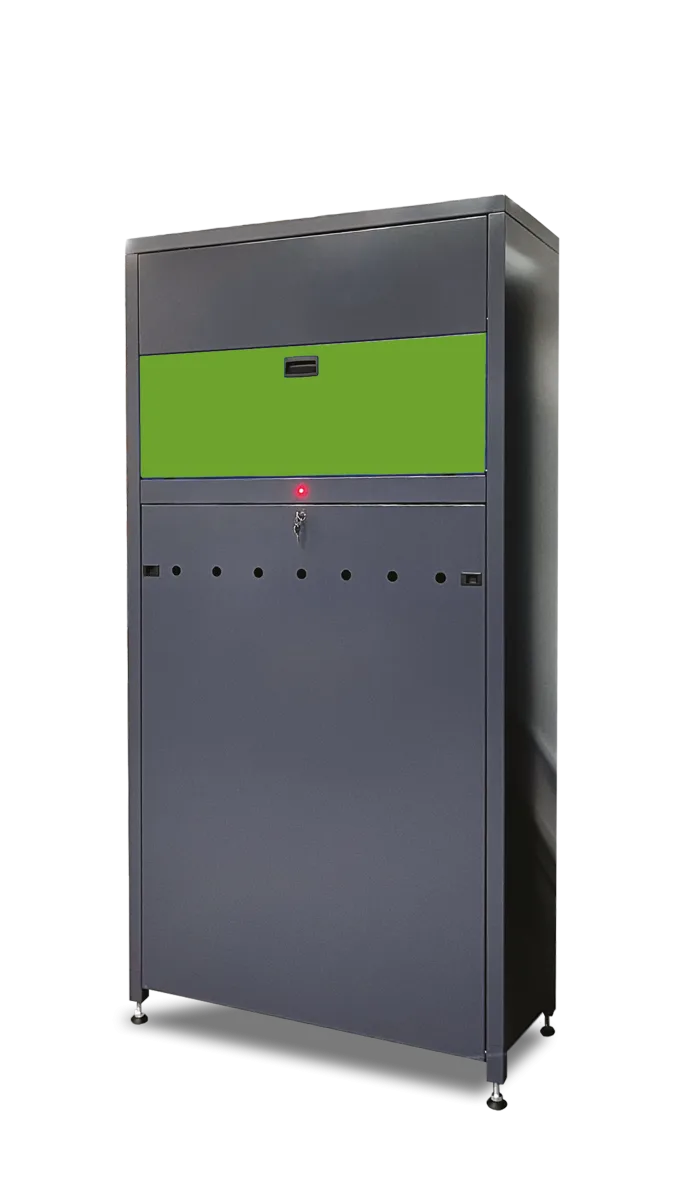
View categoryWeighing dispensers and intelligent systems
Fast dispensing without scanning. Stock is booked automatically from the exact change in weight.
View categoryServices and support
From designing the solution through installation to ongoing service and software updates.
Financing
You can buy the machine or rent it. Both routes end in the same place.
A no-obligation quote within 48 hours
Request a quoteGuide
Manufacturing employs a fifth of the people in Slovakia and accounts for a third of registered accidents at work. This guide sets out what the law asks of a production site when it comes to machines and protective equipment, which eye protection standard has ceased to apply, and why the labour inspectorate most often criticises issuing records and checks on use.
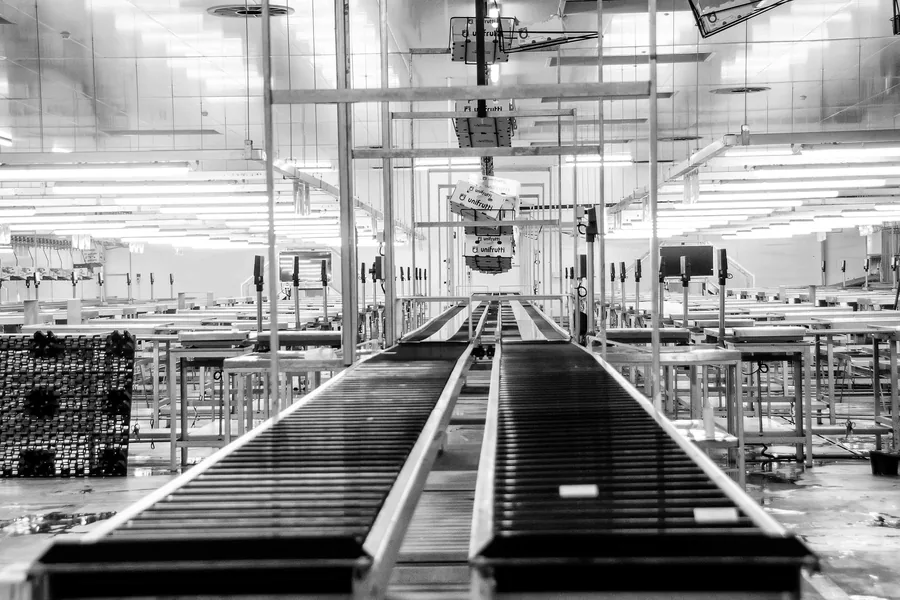
For 2025 the National Labour Inspectorate recorded 7 511 registered accidents at work in Slovakia. Of these 24 were fatal, the same as the year before, 50 involved serious injury and 7 437 were others with more than three days of incapacity.5
Manufacturing accounted for 2 588 of them, that is 34,8 %. That is the highest share of any sector in the SK NACE classification. For accidents with serious injury the ratio is sharper still: 15 of 50 cases, or 30%.6
The number says little until it is set against employment. In the public statistics, around 496 500 people worked in manufacturing in 2025, which is 20.5% of employment in the Slovak Republic.12 So a sector with a fifth of the jobs carries more than a third of the accidents. Dividing one share by the other gives an above-average burden of roughly 1.7 times.
The industry itself describes how large the sector behind those figures is. According to the Automotive Industry Association of the Slovak Republic, the automotive industry accounts for more than 52% of industrial production and 42.6% of exports, and provides work directly or indirectly for more than 256 thousand people. In 2025, 1 070 000 cars were built in Slovakia.13 The duties described below apply in the same way to a large carmaker and to a supplier with a single line.
| Source | Number | Share |
|---|---|---|
| Working and traffic areas as a source of falls | 2 212 | 29,75 % |
| Improper handling of loads and falling objects | 2 130 | 28,64 % |
| Machines | 668 | 9,0 % |
| Tools and hand tools | 661 | 8,9 % |
Vehicles added a further 644 accidents and lifting equipment with conveyors 202.5 Most accidents do not happen while operating a machine but while moving around the hall and handling material, which is exactly where footwear, gloves and goggles are worn.
The European comparison shows the same thing from another angle. According to Eurostat, Slovak manufacturing accounted for 2 961 non-fatal accidents at work in 2023, the highest absolute count of any sector. In 2024 the figure was 2 914.11 The sector's share of all non-fatal accidents reached 36.9% in Slovakia against a European Union average of 18.5%. Reporting levels differ widely between countries, so the incidence rates themselves cannot be compared. The structure can be, and it says that production carries twice the share of accidents here that it does in the union as a whole.
Occupational diseases come out much the same. In 2025, 154 cases were reported in manufacturing, half of all recognised occupational diseases in the Slovak Republic. The most common diagnosis, upper limb disorders from long-term repetitive strain, appeared in 184 cases, 59.7% of all those recognised.5
The basic rule for machines on a line is Government Regulation No. 392/2006 Coll. on minimum health and safety requirements for the use of work devices. It has applied since 1 July 2006 and has never been amended.1
The first duty concerns selection. A work device must be suitable for the job or adapted to it, and in choosing one the employer takes account of the particular working conditions, the kind of work and the hazards present at the workplace, under Section 3(1). The second duty, criticised far more often in practice, concerns inspections.
The wording of the provision
"For a work device whose inspections and tests are not laid down by legislation or other rules on ensuring occupational health and safety, the employer determines the scope and frequency of inspection."Section 5(3) of Government Regulation No. 392/2006 Coll.
That sentence is easy to miss, even though it shifts responsibility. If no intervals exist anywhere for a particular machine, it does not mean the machine need not be inspected. It means the site itself has to set the scope and frequency and be able to evidence it.
On top of regular inspection there is a special inspection by an authorised person whenever exceptional circumstances arise, in particular a modification, a fault, an accident, a natural event or a longer break in use, under Section 5(2). The employer must keep the inspection records so that they are available to supervisory authorities at any time if needed. Where a device is used away from the workplace, the records of the last inspection must be at the place of use, under Section 5(4).
Three duties follow, and together they are the first thing an inspector looks for.
Who may carry out the inspections is specified by the National Labour Inspectorate: an authorised legal person under Section 14(1)(d) of the health and safety act, or an accredited independent type A inspection body under STN EN ISO/IEC 17020 in the field of machinery.10
For forming machines the intervals and the method of inspection are set by clause 7.3 of STN 21 0700. The standard is listed as valid in the ÚNMS SR catalogue, with an edition dated 13 December 1985 and a last amendment from March 1997.810 So presses and forming machines are still governed by a document older than the regulation on work devices and older than the health and safety act.
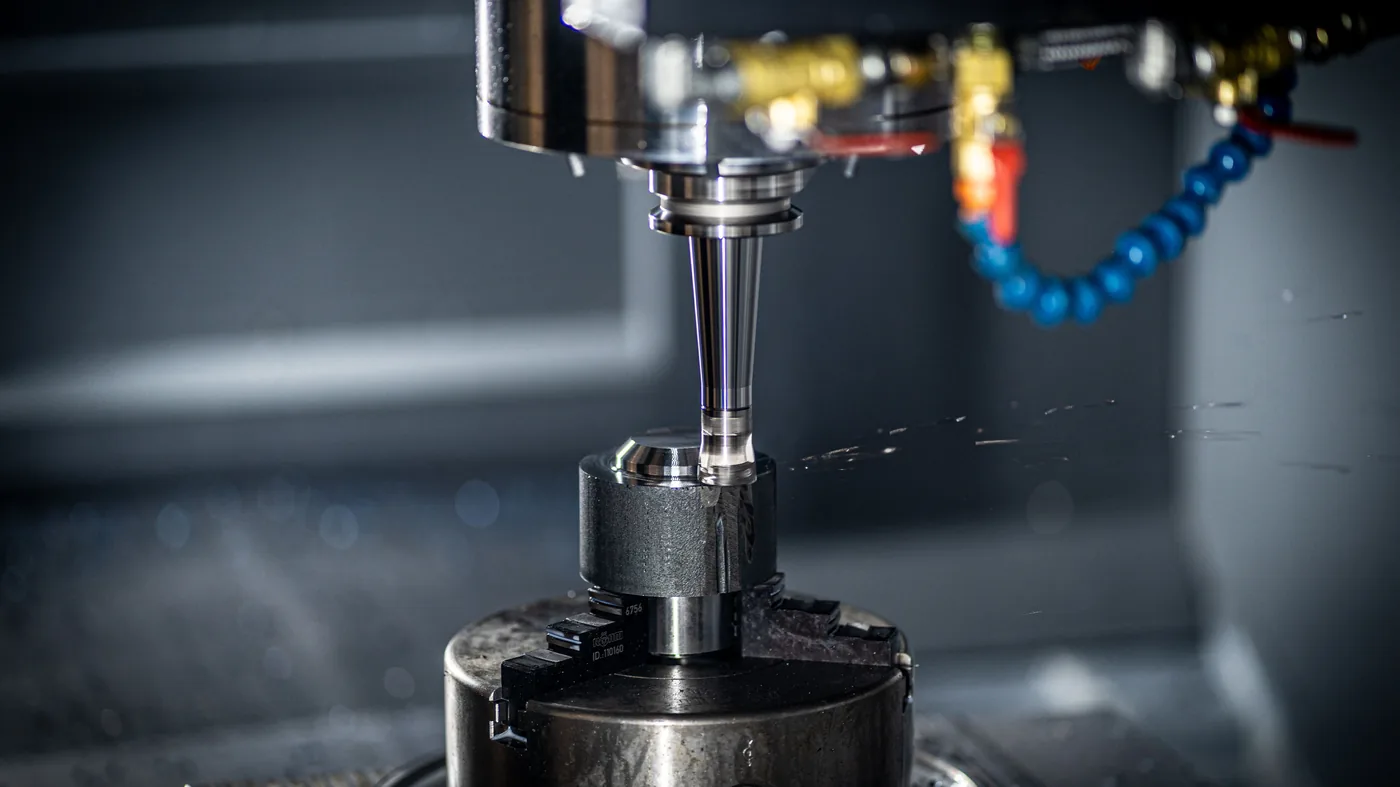
Annex 2 to the regulation deals with layout and use. A device must be installed and used so that the danger to the operator and to others is reduced, for example by leaving enough room between moving parts and fixed or moving parts around them. Assembly and dismantling must be done in safe conditions and according to the manufacturer's instructions. A self-propelled mobile work device, a forklift truck included, may be operated only by an employee trained to operate it safely, and internal traffic rules must be issued for movement within the working area.1
What the inspectorate finds with machines
According to the 2025 report, machines and designated technical equipment generate more findings than any other inspected area. The inspectorate says companies ignore the dates of expert and official tests, keep no operating logs, and often run equipment with guards missing. That technical condition, combined with poorly trained operators, is among the most common causes of accidents at work.
Personal protective equipment is not the first line of protection but the last. It is provided where the danger cannot be eliminated or limited by technical means, by collective protection or by the organisation of work.4 In production that point is reached at practically every operation involving cutting, grinding, welding or handling sharp edges.
The starting point is not a supplier's catalogue but your own list. Government Regulation No. 395/2006 Coll., in the wording in force since 20 November 2021, requires in Section 5(1) that the employer provide PPE according to its own list drawn up from the risk assessment, and that the list specify particular types of equipment for each kind of work. The list is reviewed after every assessment of suitability.
Annex 3 to the regulation contains three tables of work by physical, chemical and biological hazards. These rows matter for a production hall.4
| Hazard | Type of PPE | Work it is used for |
|---|---|---|
| Mechanical injuries: abrasions, punctures, cuts and stab wounds | protective gloves for the hands | work on steel structures, handling items with sharp edges, changing blades on cutting machines |
| Flying fragments, chips and dust | spectacles, goggles or a face shield | welding, forging, cutting, chiselling, drop forging, blasting |
| Noise | hearing protection | work with metal presses, work with tools, work with powered tools, work with wood or textiles |
| Static compression of parts of the body | footwear with a safety toecap | load handling |
| Vibration | protective gloves for the hands | work with hand-held tools |
| Solid aerosols: dust, fumes, smoke, fibres or nanomaterials | respiratory protection against particles | grinding or polishing surfaces, welding |
The annex also names sectors for each row. For gloves, vibration and aerosols it expressly mentions manufacturing and the metalworking, woodworking and automotive industries; for noise, metallurgy and processing. The list of work is not exhaustive, though. The National Labour Inspectorate adds that other work may also require the employer to provide PPE, which is why hazards and risks have to be analysed carefully.9
The same source explains why lists fail on inspection. Naming a category is not enough; the type has to be named for the particular job. The inspectorate illustrates this with footwear: protective footwear with a puncture and cut resistant sole for work with concrete elements, anti-slip footwear for work on a slippery floor, and antistatic footwear for work spent mostly standing. Those are three different items, not one.9
One more point from the same source is worth quoting during tenders.
Position of the labour inspectorate
"The criterion when choosing PPE is not its price but above all its suitability for the work in question, effective protection against existing and foreseeable hazards, meeting ergonomic requirements, and meeting the requirements of a special regulation."National Labour Inspectorate, questions and answers, Providing personal protective equipment
Section 3(1) of the regulation further requires the equipment to meet ergonomic requirements, to suit the employee's state of health and, after any small adjustment needed, to fit their body. The European Agency for Safety and Health at Work points out that a poor fit makes people less willing to wear the equipment, and that simply scaling the pattern down does not solve it, because different shapes are needed, not only different sizes.7 A range of sizes is therefore not a comfort question but a compliance one.
Section 6(1) of the regulation also requires the employer to set the conditions of use, in particular how long equipment is used for. The German trade rule DGUV Regel 112-195 on protective gloves shows how far that can be spelled out: the operating instruction must state both the wearing time and a glove replacement plan.14 It is not binding in Slovakia, but it shows what established European practice understands by setting a period of use. And a replacement plan only means something when a spare pair is available at the workplace when the employee needs it.
It makes sense to give the specific type in the list together with the standard the equipment is certified to. This is exactly where an out-of-date reference slips into documentation most easily.
Standard STN EN 166 for eye protection was withdrawn on 30 April 2025. It was replaced by STN EN ISO 16321-1 and STN EN ISO 16321-3.8 If your PPE list or enquiry sheet still refers to EN 166, it refers to a document the catalogue of Slovak technical standards no longer lists as valid.
| Standard | What it covers | Status |
|---|---|---|
| STN EN 388+A1 | Protective gloves against mechanical risks | valid, edition of 1 May 2019 |
| STN EN 166 | Personal eye protection. Specifications | withdrawn on 30 April 2025 |
| STN EN ISO 16321-1 and -3 | Eye and face protection for occupational use | valid, edition of 1 February 2023, amendment A1 of 1 May 2026 |
| STN EN 352-1 | Ear-muffs | valid, edition of 1 March 2021 |
| STN EN 352-2+A1 | Ear-plugs | valid, edition of 1 October 2024 |
| STN EN ISO 20345 | Safety footwear | valid, edition of 1 January 2023, amendment A1 of 1 December 2024 |
For welding workplaces there is a separate part, STN EN ISO 16321-2, which is also valid. With safety footwear, note that the older edition based on ISO 20345:2011 was withdrawn as of 31 March 2023, so a reference to the 2012 version is now as out of date as a reference to EN 166.8
Besides harmonised standards, the equipment must meet product legislation. According to the National Labour Inspectorate that is Regulation (EU) 2016/425 of the European Parliament and of the Council on personal protective equipment, which replaced Directive 89/686/EEC.9 When taking delivery that means CE marking and a declaration of conformity, not just a delivery note.
What to take from this
The list of PPE provided is not a document you draw up once and file. The standards it refers to change even when nothing changes on site. That is why Section 5(3) of the PPE regulation requires the list to be reviewed after every assessment of the suitability of the equipment provided.
Act No. 124/2006 Coll. on health and safety, in the wording in force since 1 July 2025, joins provision and records in one sentence. They are not two separate duties where one could be met without the other.
The wording of the provision
"To ensure occupational health and safety through personal protective equipment, the employer must a) draw up a list of the personal protective equipment provided, based on the risk assessment, b) provide free of charge, to employees whose life or health requires it, the necessary effective personal protective equipment and keep records of its provision, c) keep the personal protective equipment in usable and working condition and see to its proper use."Section 6(2) of Act No. 124/2006 Coll., with references to special regulations omitted
Four rules come on top, and together they shape how issuing should work in production.
Neither the act nor the PPE regulation prescribes the form of the records. What is required is that they are kept, that they capture provision to a named employee, and that they are available for five years. A paper card and an electronic record are equal in that respect; they differ only in how reliably they hold up under shift work and staff turnover.
Instruction deserves attention of its own. It is repeated at least once every three years, but the employer must also give it on hiring, on transfer to another workplace, and on the introduction of new technology, a new working procedure or a new work device under Section 7(3). Every change on the line is therefore a reason to instruct, not just the passing of the three year period.

The 2025 report on the state of occupational safety names the problem unusually directly. It is not primarily that protective equipment is missing.
Finding of the labour inspectorate
"Employees often fail to use PPE for no reason, even where it has been correctly issued. The causes are poor working habits and individual irresponsibility, as well as an employer control system that does not work."Report on the state of occupational safety and on the activity of the National Labour Inspectorate for 2025
The statistics on causes show the same. In 2025, missing, inadequate or unsuitable PPE was recorded as the cause of 8 cases, while failure to use the PPE prescribed and issued accounted for 84 cases. Over the eleven years from 2015 to 2025 the ratio is 914 to 145, roughly six to one.5
Both numbers are small against the total, because 78.15% of accidents end up in the catch-all category of shortcomings in personal fitness for the work. What they say lies in the ratio between them. If for every accident caused by missing equipment there are ten caused by not using what was issued, holding more stock in the store solves the smaller part of the problem.
On inspections the same group of shortcomings keeps coming up.5
In numbers, 2025 looks good in this area. Inspectors recorded 598 PPE shortcomings, 27.78% fewer than the 828 in 2024. In manufacturing as a sector, though, the total number of findings rose by 12% to 7 733, putting the sector second only to transport and storage.5
That this is about management rather than paperwork is confirmed from outside state supervision as well. The International Social Security Association built its Vision Zero strategy on seven rules, in which the safety of machines, equipment and workplaces is rule five, raising qualifications rule six, and involving employees rule seven.15 Those are three separate jobs for company management. The Slovak inspectorate finds shortcomings in all three.
The inspectorate's assessment
According to the report, the main problem at Slovak workplaces remains a formal attitude to health and safety. Employers treat it mainly as protection against penalties rather than as a way of actually protecting health. The safety service prepares the documentation for them, but in practice nobody works with it. Employers often lack an internal risk assessment and neglect training, so employees themselves are not actively involved in protecting their own health. The inspectorate sees progress mainly at larger manufacturers and at companies with foreign investors; at small employers the duties are met more formally.
Act No. 125/2006 Coll. on labour inspection, in the wording in force since 7 June 2026, lists what counts as a serious breach of duty. On that list, failing to provide PPE sits on the same level as a missing guard on a machine.
The wording of the provision
"A serious breach of the duties arising from the regulations listed in Section 2(1)(a) is [...] d) failure to provide a guard or a safety device [...] f) failure to provide the necessary effective personal protective equipment or to keep it in working order."Section 19(3) of Act No. 125/2006 Coll. on labour inspection
Being classed as a serious breach has a direct effect on the rate and on whether the inspectorate has any discretion at all. For an ordinary breach the inspectorate "may impose" a penalty. For a serious breach it "imposes" one.
| Situation | What the inspectorate does | Rate |
|---|---|---|
| Breach of duties under Section 19(1) | may impose | up to 100 000 € |
| Serious breach under Section 19(2) | imposes | 1 000 to 200 000 € |
| A breach resulting in an accident with serious injury | imposes | at least 20 000 € |
| A breach resulting in a fatal accident | imposes | at least 33 000 € |
In setting the amount, Section 19(6) requires account to be taken, among other things, of whether the breach results from an ineffective safety management system or is an isolated occurrence, and of the same shortcoming being found repeatedly. Documentation of issuing and of checks is therefore part of what is assessed when the amount is set. A site that can evidence a working system argues from a different position than one that can only produce purchase invoices.
Liability does not stop at the company either. Managers and statutory bodies who breached the duties through their own fault can be fined up to four times their average monthly earnings, and the employer's liability for the same breach is unaffected. Penalty proceedings can be started within six months of the end of the inspection and no later than three years from the day of the breach.3
Regulation (EU) 2023/1230 of the European Parliament and of the Council on machinery has been in force since July 2023, but it only applies from 14 January 2027. Some articles apply earlier. Directive 2006/42/EC, on which current practice rests, is repealed on the same day.2 The date 20 January 2027 occasionally appears in professional discussion; it is not in the text of the regulation.
For a site that buys and uses machines, two things matter.
The definition of a substantial modification is closer to everyday practice than people expect. It is a modification after the machine was placed on the market that the manufacturer did not foresee, that creates a new hazard or increases an existing risk, and that calls either for adding guards or devices with a change to the existing safety control system, or for further measures to ensure stability and mechanical strength.2
An important distinction
The machinery regulation is product legislation and addresses manufacturers, importers and distributors. The employer's duties when using machines remain in Government Regulation No. 392/2006 Coll., which transposes the European directive on the use of work equipment. The regulation does not repeal that directive, so nothing changes on 14 January 2027 for the duties described in the second section of this guide. What changes concerns what a site buys and what it rebuilds itself.
Boiled down into a brief, the previous sections leave a production site with four things to meet at once that look contradictory: have the equipment available on every shift, be able to show who received it and when, check that it is actually used, and not pass the cost to the employee.
That is exactly the job for controlled issuing at the workplace itself.
Digital issuing is nothing foreign to Slovak sites. According to the ESENER 2024 survey, 63% of Slovak organisations use digital technologies routinely, the second highest figure in the European Union against an average of 42%.7
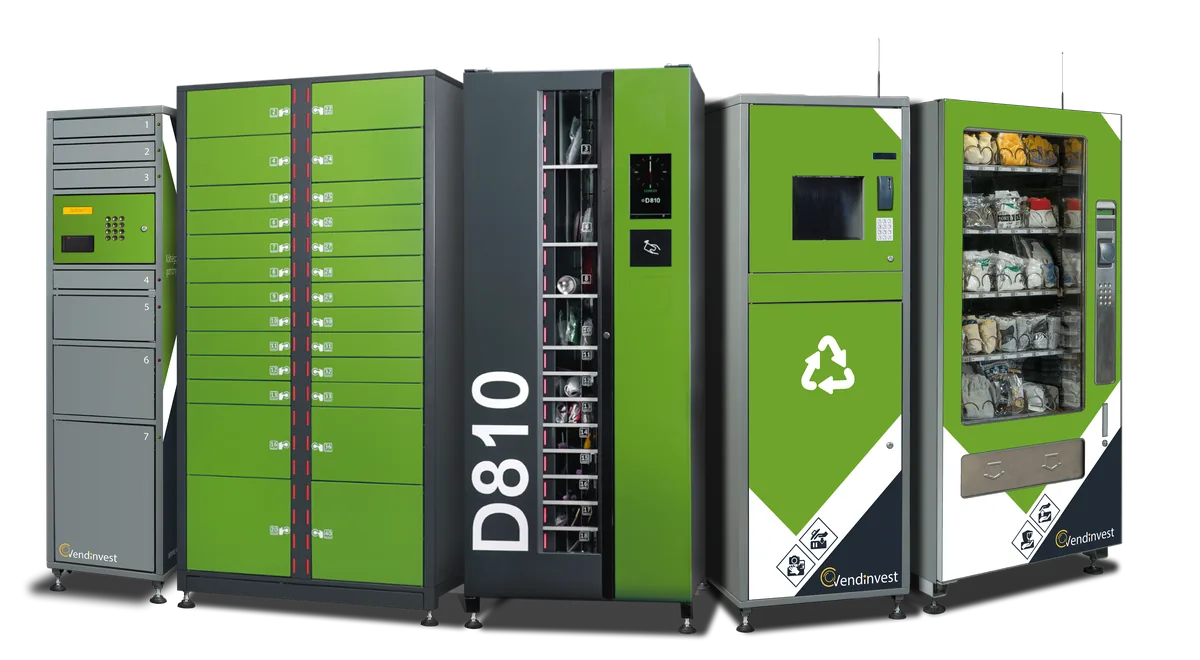
For issuing gloves, goggles, hearing protection and cutting material at the line itself, our range is most often used as spiral and lift machines, with a wider range in one place as carousel storage machines and, for bulky items, cabinet machines.
Ten questions every production site and assembly line should be able to answer.
Have we set the scope and frequency of inspection for every work device, including where no rule sets them?
Are inspection records available to the supervisory authorities at any time, and do we keep operating logs?
Can we show that both operators and maintenance staff were trained in proportion to the dangers of their work?
Does our PPE list specify particular types for each job, not just categories?
Does the list refer to valid standards, and not to the withdrawn STN EN 166 or the 2012 footwear edition?
Is protective equipment available on every shift, including nights, without the employee having to ask for it?
Can we attach a named employee and a date to every issue, and do we keep the records for five years?
Do we carry out and document checks on whether the issued PPE is actually used?
Do we instruct employees when a new work device is introduced, rather than waiting three years?
With every rebuild of a machine, can we judge whether it amounts to a substantial modification under the machinery regulation?
No. STN EN 166 was withdrawn from the catalogue of Slovak technical standards as of 30 April 2025. It was replaced by STN EN ISO 16321-1 and STN EN ISO 16321-3, both issued on 1 February 2023, with amendment A1 to part 1 dated 1 May 2026. For welding workplaces there is a separate part, STN EN ISO 16321-2.
Where legislation or a standard sets the intervals, those apply. For forming machines that is clause 7.3 of STN 21 0700, for example. Where no intervals are set, the employer decides the scope and frequency under Section 5(3) of Government Regulation No. 392/2006 Coll. A special inspection is carried out after any modification, fault, accident or longer break in use.
Under Section 19(3)(f) of Act No. 125/2006 Coll., failing to provide the necessary effective PPE, or failing to keep it in working order, is a serious breach of duty. In that case the labour inspectorate imposes a penalty of between 1 000 and 200 000 euros. If the breach led to an accident with serious injury, the penalty is at least 20 000 euros, and for a fatal accident at least 33 000 euros.
No. Neither Act No. 124/2006 Coll. nor Government Regulation No. 395/2006 Coll. prescribes the form. What is required is that records of provision are kept and that the documentation is retained for five years from the last entry, under Section 6(1)(n) of the health and safety act.
No. The employer bears the costs of ensuring occupational health and safety and must not pass them to the employee, under Section 6(11) of Act No. 124/2006 Coll. The National Labour Inspectorate adds that an employer must not sell mandatory PPE, deduct its price from wages, or recover its value in any similar way. Consumption limits and issuing records do not breach this; charging the employee does.
No. The regulation applies from 14 January 2027, and products placed on the market under Directive 2006/42/EC before that date may continue to be made available. EC type-examination certificates stay valid until they expire. Watch out for your own modifications, though. Under Article 18, anyone who substantially modifies a machine is treated as its manufacturer, with all the duties that follow.
Legislation is cited as in force on the date this guide was updated, and standards according to the ÚNMS SR catalogue as at 31 August 2026. Sources that are not Slovak legislation are marked in the list and are informative. This text is for information and does not replace legal advice or an assessment of a particular site.
Government Regulation No. 392/2006 Coll. on minimum health and safety requirements for the use of work devices
Regulation (EU) 2023/1230 of the European Parliament and of the Council on machinery
Act No. 125/2006 Coll. on labour inspection
Government Regulation No. 395/2006 Coll. on minimum requirements for the provision and use of personal protective equipment
Report on the state of occupational safety and on the activity of the labour inspection authorities for 2025
Report analysing accidents at work, occupational diseases and the threat of occupational disease for 2025
Materials from the European Agency for Safety and Health at Work
Catalogue of Slovak technical standards, entries STN EN 388+A1, STN EN 166, STN EN ISO 16321, STN EN 352, STN EN ISO 20345 and STN 21 0700
National Labour Inspectorate, questions and answers on providing and using PPE
Inspection of permanently installed work devices and testing of forming machines
Accidents at work by economic activity, data for 2023 and 2024, dataset hsw_n2_01
Employment by economic activity, domestic concept, dataset nu1025rs
Automotive Industry Association of the Slovak Republic, Výsledky máme. Podmienky na ďalší rozvoj strácame
DGUV Regel 112-195, Benutzung von Schutzhandschuhen
Vision Zero, the seven golden rules
Recommended models
Production usually combines two types: a machine at the line for small items taken often, and a larger storage machine for the range that moves more slowly.
 W40 DROPA spiral machine for gloves, goggles and cutting material
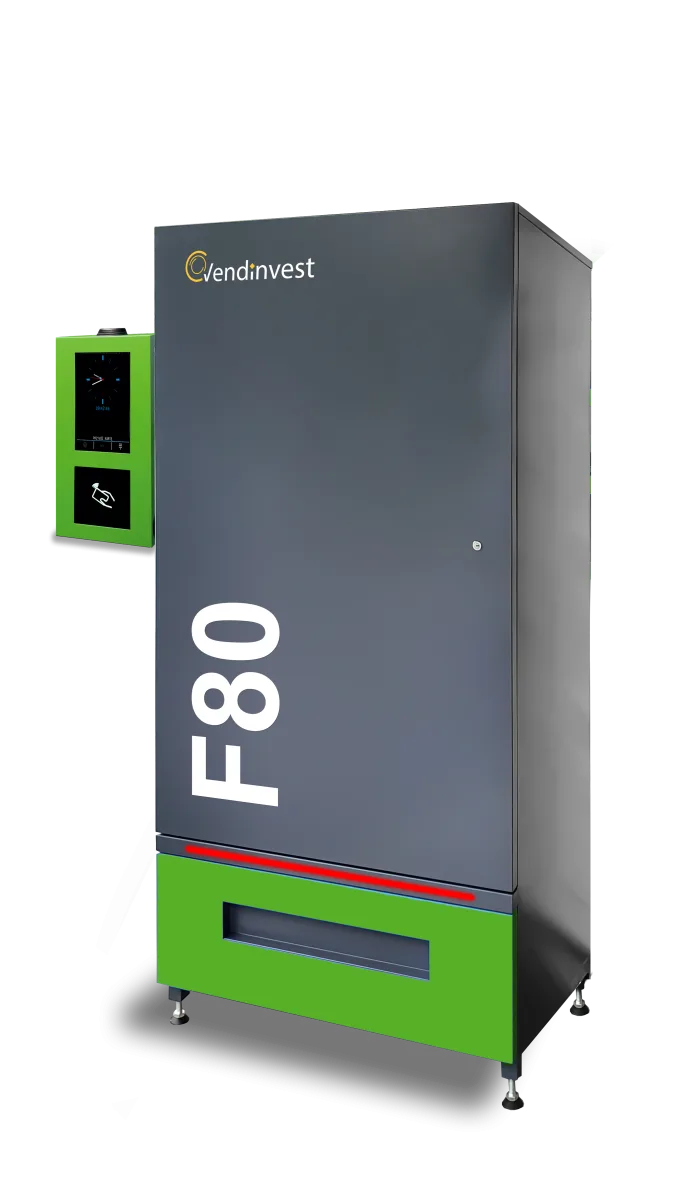 F80 BASICA compact machine for smaller workplaces and single lines
 D810A carousel machine for a wide range in one place
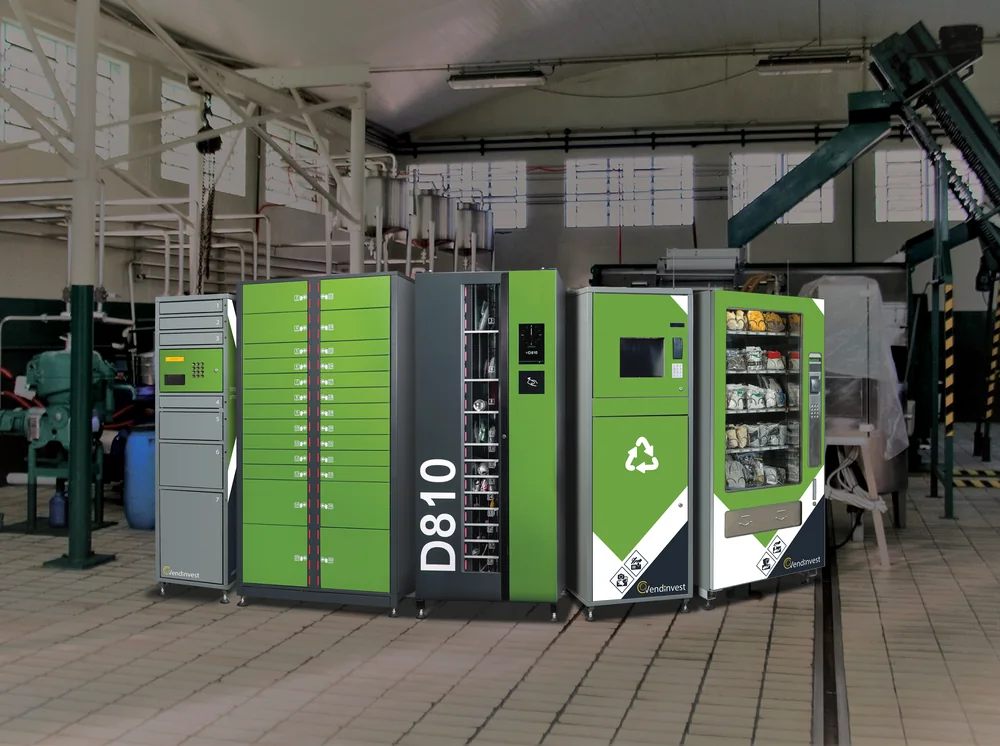
Where to next
Open a category to see what is in it. The button takes you to its page.
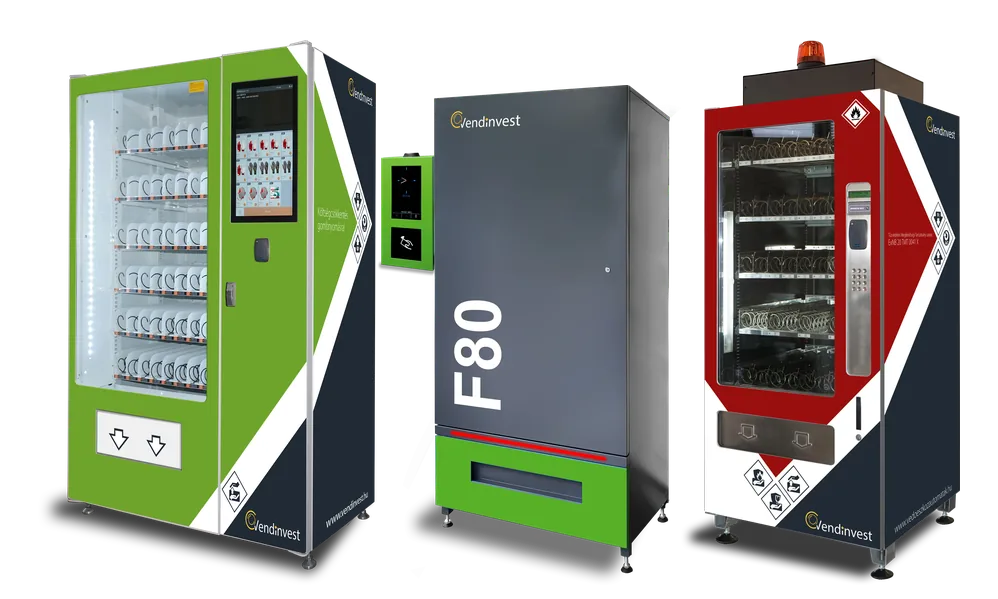
4 models · W40 DROP, W40 LIFT, W8 EX LIFT, F80 BASIC
Precise issuing piece by piece for small items: gloves, goggles, hearing protection and cutting material.
Go to the category
2 models · D810, D1080
Rotating shelves with high capacity. They suit places where several lines are served from one point.
Go to the category
3 models · SZV 15, SZB 18, L40
Large items under lock. The L40 can also charge cordless tools inside the locked cabinet.
Go to the categoryMore guides
The new rules from April 2026, volume limits and zones.
Weight limits, racking inspections and records across halls.
The authorised person, intervals and records, isolation from power.
The new act on sales records, the exemption for vending machines and deposit return.
A consultation with no obligation
Tell us how many lines you have and what is taken from them most often. We will propose a set of machines and a way of recording what is issued.